My First Enterprise Level Pull Request
I just wrapped up my first real pull request at GoDaddy, and the truth is that it hit me hard. I’m trying not to overreact, but emotionally I’m still processing it. Putting my skills alongside seasoned enterprise developers felt like a shock I wasn’t fully prepared for. It took 21 commits to get three files over the finish line. Even after multiple rounds of review, linting, installing the right extensions, dealing with configuration issues, and doing everything I thought I needed to do, the senior engineer still had to step in and adjust formatting before the code could be approved and merged. I know this is all new and extremely complex. It’s enterprise-level software, but imposter syndrome doesn’t care about context.
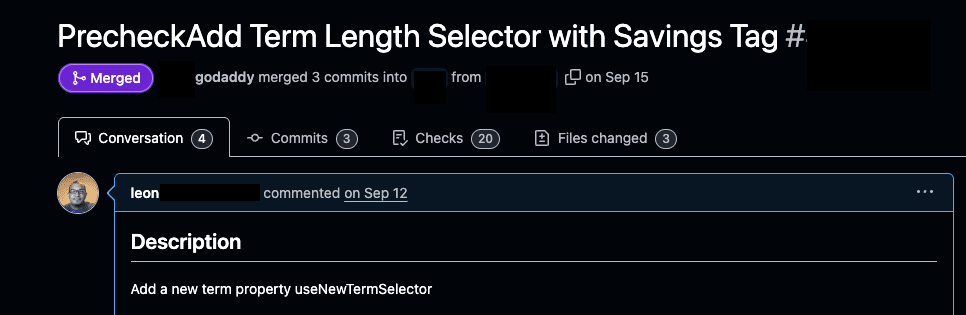
The PR itself added a whole new layer to the challenge. It crossed multiple repos, codebases, and CMS templates. I had to update our SiteCore rendering engine (SWPm) using C#, make corresponding changes to our SiteCore CMS templates, and update Pattern Library React components and their Storybook entries. The goal was to introduce a term selector that pulled different content from the content API. All of this work supported a marketing experiment on the pre-checkout cart experience, allowing us to A/B test savings tags and calculate cost savings in dollars instead of the current percentage-based experience. On paper it seemed manageable, but once I was navigating the interconnected systems, it became clear how complex enterprise architecture can really be.
My senior engineer, who pair programmed with me, is excellent at what she does. She took time to outline a plan, point me in the right direction, and review each version as I worked through it. The product manager also went to bat for me to get this opportunity, and I’m genuinely grateful. Our team is already carrying a heavy workload, and guiding me through this wasn’t something anyone planned for. Still, they made space for it, and I learned a tremendous amount from the experience.
From the start, I dove in and tried to deliver. I leaned heavily on GitHub Copilot and Cursor to understand the context and draft solutions. I got a working version, but I also made mistakes—touching files I didn’t need to, chasing the wrong approach, and trying to make sense of a large codebase without fully grasping its architecture. In the early stages, there were no walkthroughs or screenshares. I simply put my head down and tried to figure it out the best I could.
When I finally returned with version one, we iterated together until the solution was ready. It was eye-opening, challenging, and humbling. Now it’s time to reflect on what I missed, what I could have done better, and where my gaps are. How do I turn this experience into growth? How do I level up? Time to lock in.
This was my first real taste of contributing to an enterprise codebase, and while it shook me, it also motivated me. I want to improve. I want to contribute at a level where my work helps the team rather than adds to their load. And I want to look back at this first PR as the moment where things shifted from academics and personal projects into real, professional-grade software engineering.